 |
||
 |
|
|
 |
||
|
|
|
































































IMPORTANT: No material may be reproduced, copied or redistributed from this site, without the express written consent of doktorjon.co.uk
All the detailed information on this site is provided in good faith; and as such, Doktor Jon does not accept responsibility for any consequential loss, injury or disadvantage resulting from any individual or organisation acting on the details contained herein.
© doktorjon.com 2004 - 2012







![info[at]doktorjon.co.uk](Resources/item93a3c1ae.gif)


















Please Note - Doktor Jon is currently upgrading his site, so you may see some layout changes on various pages, whilst the work is in progress.
Hopefully, the complete re-design and improvements, should be completed during 2012.
To carry out a ‘basic’ TRUSTED© Assessment, there are five key areas to review:-
• The Cameras
• Transmission System
• Monitoring and Display Equipment
• The Recording System
• Legal Compliance
Basic evaluations are being developed by Doktor Jon to allow inexperienced end users the opportunity to review and gauge how well their system is performing, and to help identify key areas that may easily be improved.
This brief section will explain a little bit more about how the appraisal will work ...
Camera Assessment
Each camera in the system will need to be evaluated to see how well it is performing in terms of set up for display and recording purposes.
Whilst this analysis relates specifically to it’s role for "Incident Monitoring" and consequently "Evidential Recording", it does not at all relate to it’s possible use for either "Site Management" or "Deterrence", both of which are really outside the scope of this ‘basic’ TRUSTED© assessment.
It's worth briefly restating that in practice, the roles of Site Management and Deterrence actually have no impact on the systems suitability for gathering and displaying evidential quality images, and so can safely be disregarded for the purposes of this exercise.
Now if you want to evaluate an individual camera, you have to display it (unprocessed) directly onto a suitable monitor, which for this basic evaluation, will almost certainly be the main display screen.
Just for your information, with a more detailed professional assessment, this would normally require picture analysis to be done in two distinct stages.
Firstly using a high quality test monitor connected directly to the camera with a short signal lead, this makes it easy to gauge the overall quality of the image coming straight out of the camera. Some IP Cameras provide a 'Video Out' socket to allow this test, but if it's not available, then the camera can either be connected to a good quality laptop (assuming the camera is externally powered), or through a PoE adaptor which can be purchased seperately.
In the second stage, the cameras performance would then be compared against the perceived quality of image at the monitoring end, so that any inadequacies in the transmission system can be easily identified, and hopefully remedied - in practice, this evaluation can be achieved with or without the use of technical measuring equipment, although it does require some degree of technical knowledge to diagnose or determine the cause of any obvious visible shortcomings.
For the purposes of this basic assessment, you need to define a specific target recognition zone in the picture; now this could be just part of the image, or indeed in some situations, absolutely everything shown on the screen ..... this zone is the vital area where your camera should be optimised for target recognition.
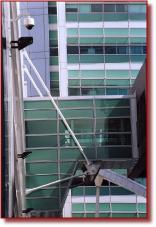
How can you tell if your
Video Surveillance System
is 'TRUSTED'©
Whilst the "TRUSTED"© campaign is about raising awareness of how to improve the quality of images and recordings, it is vitally important that CCTV users have a relatively simple way of measuring their systems effectiveness, for identifying and recording defined targets.